
Article
Local Keyword Research for Contractors
By Raid Contractor Marketing · · 4 min read

Local keyword research methods pair a core service term with a location modifier, such as "plumber Nyc," then validate demand using search tools, competitor gap analysis, and Google Business Profile insights. Contractors use free templates to organize keyword + city combinations, track search volume, and prioritize pages that convert local searches into booked jobs.
What is local keyword research for contractors?
Local keyword research is the process of discovering the exact search terms homeowners in a specific service area type into Google. These queries combine what a contractor offers with where the contractor operates. A typical example is "plumber nyc," which pairs a service term with a location modifier. This research reveals the language real customers use, which often differs from industry jargon.
Contractors who skip this step lose visibility to competitors who understand local search behavior. People rarely search for "HVAC maintenance plans" when they are actually typing "furnace repair near me." Understanding these real-world phrases helps a business appear in front of motivated buyers. The goal is to capture traffic from searchers who are ready to book a service, not just browse.
Contractor keywords form the foundation of this research. These terms cover the full range of services a trade offers, from emergency repairs to routine maintenance. Pairing those terms with [service area keywords](https://raidcontractormarketing.com/industries) creates a targeted list of phrases with high purchase intent.
How do local keywords differ from regular keywords?
Regular keywords target a broad audience with no geographic focus. Local keywords add a location element that filters results to a specific city or neighborhood. A roofer targeting "storm damage repair" competes nationally, but "storm damage repair austin" reaches only nearby homeowners. This distinction matters because local searchers show higher conversion intent. They are comparing options and often ready to call within minutes.
Why do contractors need geo-modified keywords?
Geo-modified keywords anchor a business to its physical service area. These terms signal relevance to both Google and the searcher. When a homeowner searches for "ac repair phoenix," the search engine prioritizes businesses with strong local signals. Contractors who optimize for these terms appear in the map pack and organic results. Missing these phrases means losing ground to competitors who invested in near me keyword research and location-specific pages.

How do you find the right contractor keywords?
Finding the right contractor keywords starts with a business's own data, not a third-party tool. The highest-leverage keyword opportunities are the sleeping giants already sitting in a company's Google Search Console data. These are real queries people already used to find the site, and they represent immediate, untapped potential. Ignoring this data means leaving easy wins on the table.
What three layers should a seed list include?
A proper seed list for local keyword research must cover three distinct layers. The first layer is the core service term, such as "furnace repair" or "roof replacement." The second layer adds modifiers like "emergency," "same-day," or "affordable." The third layer incorporates geography, including both city names and specific neighborhoods.
- Service terms: The core trade (HVAC, plumbing, roofing)
- Modifiers: Urgency, quality, or price signals (emergency, licensed, cheap)
- Geography: Cities and neighborhoods (Austin, South Congress, Oak Hill)
How does near me keyword research work?
Near me keyword research captures high-intent local searchers ready to book a job. Queries like "plumber near me" signal immediate need and a willingness to hire. However, stuffing the phrase "near me" into website content is a mistake. Google interprets location from the searcher's device, not from on-page text. The smarter approach is to optimize for service area keywords and geo-modified keywords like "Austin HVAC contractor" or "roofer in Oak Hill." These terms match how customers actually search and how Google evaluates relevance.
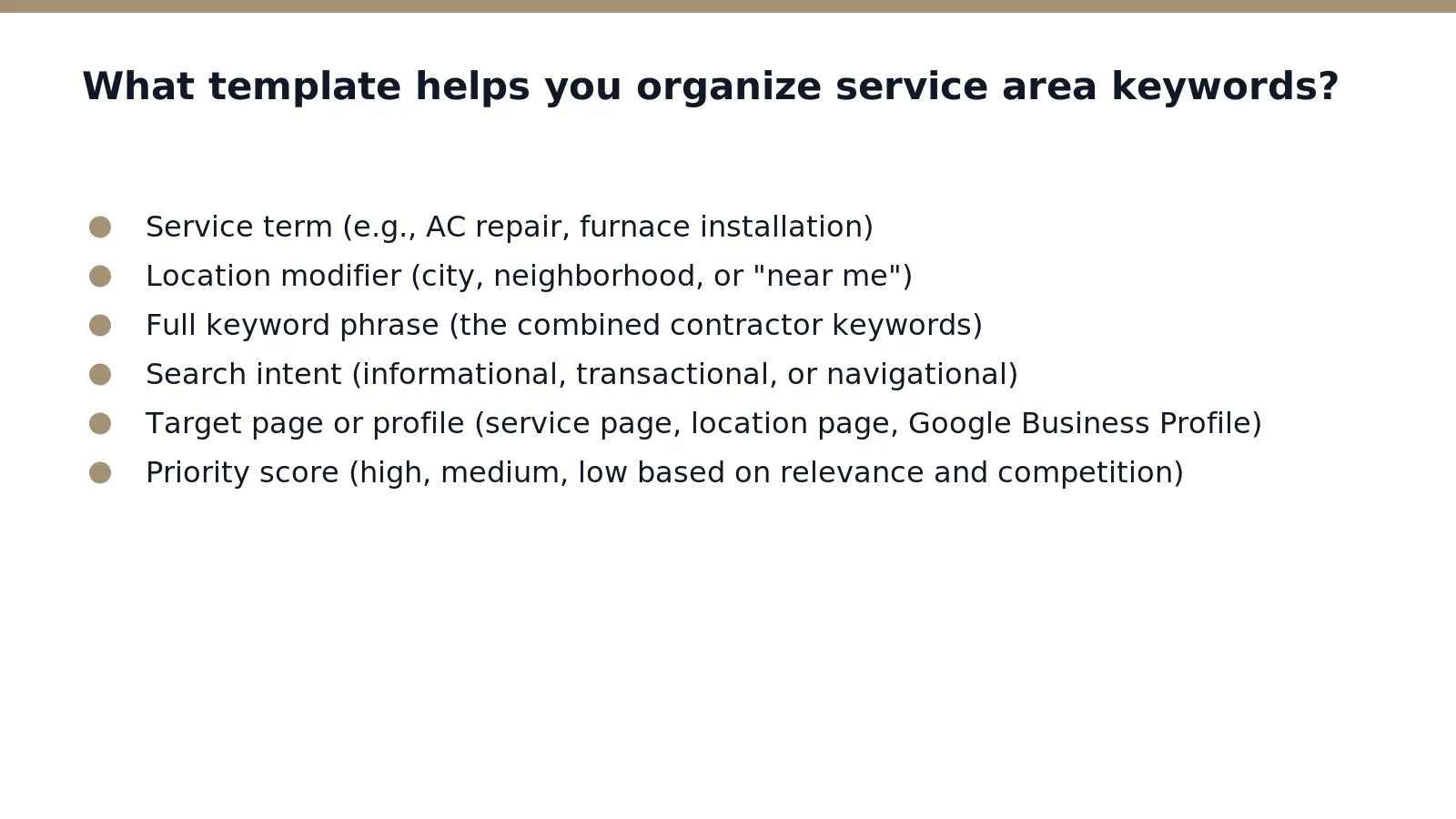
What template helps you organize service area keywords?
A free template helps contractors organize service area keywords by combining service terms with city and neighborhood names. This structured approach turns scattered keyword ideas into a clear, actionable list that maps directly to local search intent.
Contractors can use a simple spreadsheet template with columns for the service, the location modifier, and the full geo-modified keywords. For example, a roofer in Denver would list "roof repair" in the service column and "Denver" in the location column, producing "roof repair Denver." The template also includes a column for search volume estimates. A column for the target page or Google Business Profile section.
How does a template account for AI search results?
AI search has expanded how customers discover and compare local services. Keyword research now needs to account for AI-generated answers, not just traditional ranked results. A good template includes a column for question-based queries like "best plumber near me" or "how much does a new roof cost". Phrases that AI engines pull into featured snippets.
What columns should a contractor keyword template include?
- Service term (e.g., AC repair, furnace installation)
- Location modifier (city, neighborhood, or "near me")
- Full keyword phrase (the combined contractor keywords)
- Search intent (informational, transactional, or navigational)
- Target page or profile (service page, location page, Google Business Profile)
- Priority score (high, medium, low based on relevance and competition)
Raid Contractor Marketing ensures every call is answered and every lead is handled, turning searches into potential jobs. Mapping service area keywords to the right pages. Profile optimizations lets contractors track their impact on local visibility and conversions. A free template makes this mapping systematic and repeatable.
Conclusion
In closing, mastering local keyword research transforms how contractors connect with customers actively searching for their services. By implementing the templates and methods covered here, you build a foundation for visibility that drives qualified leads to your business. The contractors who invest time in understanding their local search landscape gain a competitive edge that compounds over time, turning neighborhood searches into steady job opportunities and sustainable growth.