
Article
Multi-Location Websites: Best Practices for Contractors
By Raid Contractor Marketing · · 4 min read

Multi-location contractor websites require unique location pages with individual schema markup, localized service content, and NAP consistency across all city or territory pages. Google's local search guidelines favor dedicated landing pages over duplicated templates. Raid Contractor Marketing builds scalable site architecture for HVAC, roofing, plumbing, and electrical brands, pairing each location page with an AI receptionist that converts local traffic into booked jobs.
What makes multi-location websites different?
Multi-location websites demand a fundamentally different approach than single-location sites. A strategy that works for one service area often falls apart at scale. Shortcuts like duplicating pages or copying listings quietly tank rankings across every location.
There is no single template that fits every business. A five-location regional HVAC company may require different architecture compared to a two-location plumbing startup, depending on factors like service area size and business goals. Each structure requires its own local landing page structure and content plan.
Raid Contractor Marketing builds websites specifically for home-services contractors. The team understands the unique needs of multi-location HVAC, roofing, plumbing, and electrical businesses operating across multiple service territories.
Why does a single-location approach fail for multi-location contractors?
A single-location strategy assumes one service area, one set of reviews, and one local search presence. Multi-location operations need distinct pages, unique content, and separate citations for each territory. Reusing the same content across locations signals duplication to search engines, which suppresses visibility everywhere.
How does site architecture for contractors differ at scale?
Site architecture for contractors must separate each location into its own logical branch. This structure supports location seo by ensuring each service area is uniquely indexed, which can improve visibility in local search results. A proper multi-site strategy organizes locations under one domain while keeping each city page distinct, which preserves authority while maximizing local relevance.

How should you structure local landing pages?
Local landing page structure determines whether a contractor ranks in each service area or gets penalized for duplicate content. The Multi-Location SEO: The Complete Strategy Guide warns that duplicating pages, copying listings, and reusing content across locations quietly tanks rankings at scale. What works for a single-location business falls apart when applied to multiple cities.
What makes a location page unique?
Every city page needs original content written for that specific service area. The Multi-Location Website Design Guide (w/Best Practices) explains that the core decision is whether to build separate websites per location or one domain with individual city pages. The right answer depends on distance between locations and whether the contractor serves a defined service area. Site architecture for contractors must treat each location as an independent ranking entity.
How does Raid Contractor Marketing approach this?
Raid Contractor Marketing builds each location page around the contractor's specific trade and service territory. The brand's approach embodies professionalism and transparency, ensuring no two pages read the same. This prevents Google from flagging content as thin or duplicated.
Multi-site strategy requires three elements per location page:
- Unique service descriptions written for that city's common problems
- Local landmarks, neighborhoods, and zip codes mentioned naturally
- Separate Google Business Profile listings tied to each page
Location SEO rewards contractors who invest in original content per city. A roofing contractor in Halifax needs different page copy than one in Dartmouth, even when services overlap. The penalty for shortcuts is invisible rankings across every location.
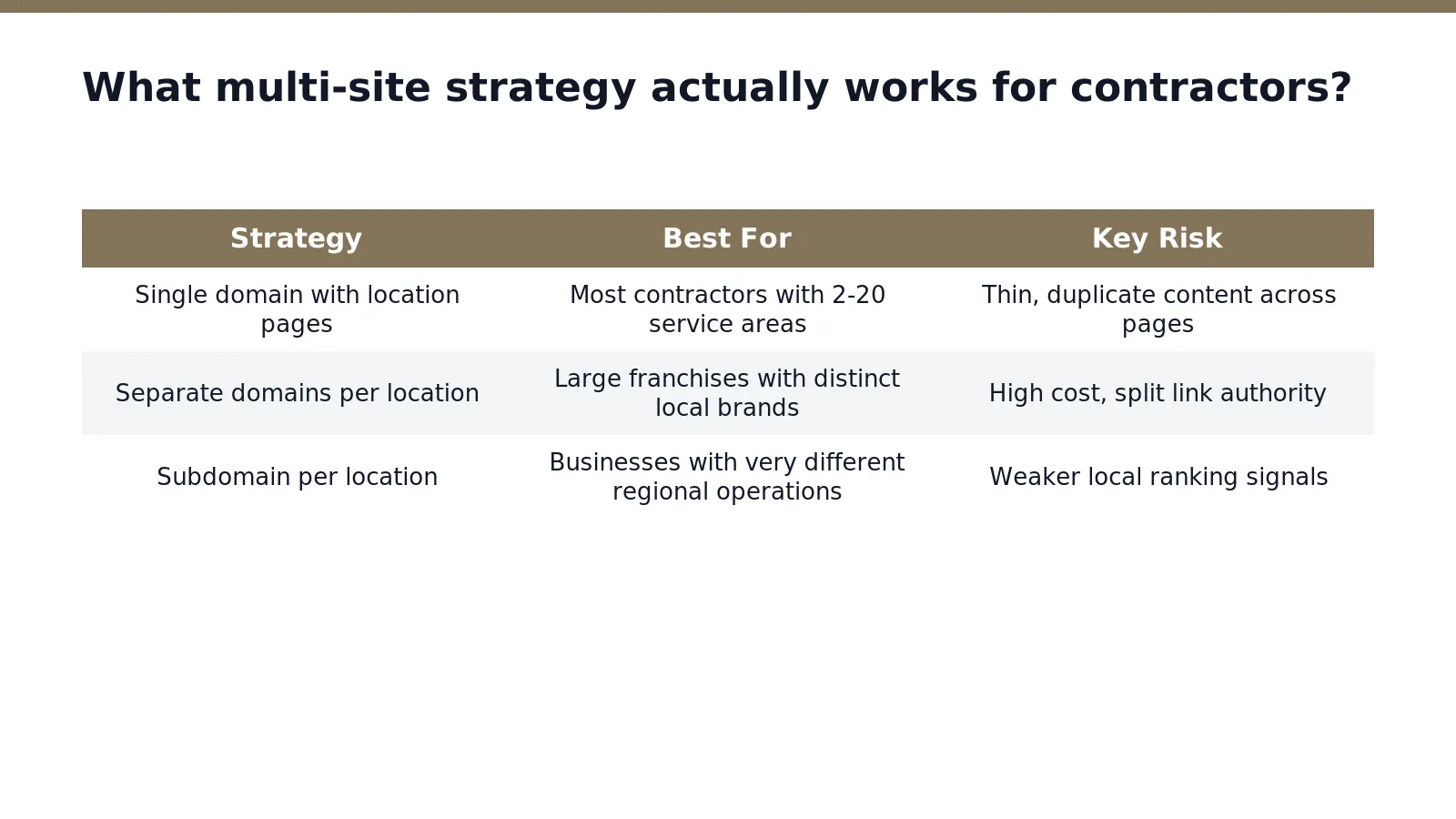
What multi-site strategy actually works for contractors?
A multi-site strategy for contractors must balance a strong central domain with location-specific pages. This approach maximizes visibility in each target market without diluting the main brand's authority. Contractors managing multiple service areas need a scalable architecture that ranks locally and converts leads.
How does a single domain with location pages compare to separate sites?
| Strategy | Best For | Key Risk |
|---|---|---|
| Single domain with location pages | Most contractors with 2-20 service areas | Thin, duplicate content across pages |
| Separate domains per location | Large franchises with distinct local brands | High cost, split link authority |
| Subdomain per location | Businesses with very different regional operations | Weaker local ranking signals |
For most HVAC, plumbing, electrical, and roofing contractors, a single domain with dedicated location pages delivers the best return. This site architecture for contractors keeps all link equity on one domain while targeting each city individually.
What location SEO tactics drive results?
Location SEO best practices start with optimizing Google Business Profiles for each service area. Contractors must manage reviews actively and build local citations across directories. These signals tell Google which neighborhoods a business serves. Raid Contractor Marketing provides fast and reliable marketing services that ensure every call is answered and every lead is handled across all locations.
How should contractors structure local landing pages?
Local landing page structure requires unique content for each city. Duplicate pages with swapped city names hurt rankings. Each page needs original service descriptions, local project photos, and area-specific testimonials. A strong multi-location websites approach uses consistent navigation and branding while making every city page feel local.
Conclusion
In closing, managing multiple locations demands a cohesive digital strategy that maintains brand consistency while serving local markets effectively. By implementing location-specific pages, localized SEO, unified lead management, and streamlined communication systems, contractors position themselves to capture opportunities across their service areas. The contractors who succeed treat their multi-location presence as an integrated operation, not isolated branches, ensuring every customer interaction reflects the same professionalism and reliability, regardless of which location they contact.